PygenRay
rhymes with “eigen-ray”
Modern python based ray code for modelling underwater acoustic propagation, built on top of existing numerical integration methods in scipy :mod:scipy.integrate. This allows for more specific control over the numerical integration methods used for solving the ray equations.
Warning
Some of the main functionality of this package is still under development. If you run into any errors, please feel free to submit an issue. I may or may not be able to get to it, so you might also have to play around with trying to fix it yourself.
Quick Start
Installation
pip install pygenray
Run a simple ray code
Set up the environment, model parameters and shoot a ray fan.
import pygenray as pr
import numpy as np
import matplotlib.pyplot as plt

source_depth = 1000
source_range = 0
launch_angles = np.linspace(-20, 20, 1000)  # launch angles in degrees
receiver_range = 100e3  # receiver range in meters
num_range_save = 10000  # number of range points to save
environment = pr.OceanEnvironment2D()
receiver_depths=[1000]

rays = pr.shoot_rays(
    source_depth,
    source_range,
    launch_angles,
    receiver_range,
    num_range_save,
    environment,
)
Solve for eigen rays
eigenrays = pr.find_eigenrays(
    rays,
    receiver_depths,
    source_depth,
    source_range,
    receiver_range,
    num_range_save,
    environment
)
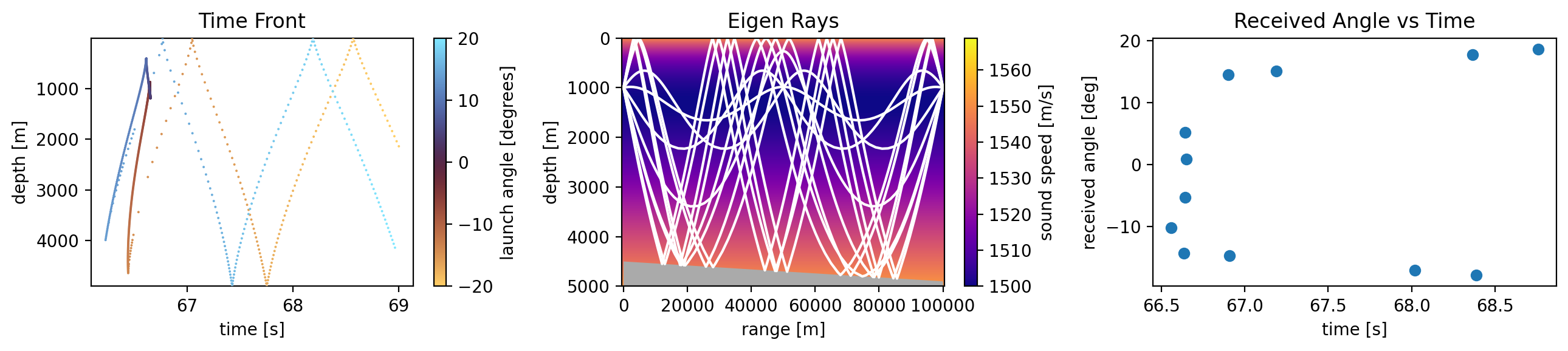
Plot time-front, arrival times and angles, and eigenray paths.
fig = plt.figure(figsize=(13,3))

plt.subplot(1,3,1)
rays.plot_time_front()

plt.subplot(1,3,2)
environment.plot(cmap='plasma')
eigenrays.plot(c='w')

plt.ylim([5000,0])
plt.subplot(1,3,3)
eigenrays.plot_angle_time()

plt.tight_layout()